


Förstå kroppssammansättning hos äldre vuxna med CKD
För äldre vuxna som lever med kronisk njursjukdom (CKD), hälsotillståndet är mycket mer komplext än vad en siffra på skalan kan berätta för oss.
Kroppsvikten kan förbli relativt stabil medan muskelmassan minskar, kroppsfett ökar, och fysiska funktionsförändringar.
Det är därför forskning inom geriatrik och hantering av kroniska sjukdomar alltmer ser bortom vikt och BMI mot en mer fullständig förståelse av kroppssammansättningsanalys.
A 2026 studie utförd av forskare vid ”Iuliu Hatieganu” University of Medicine and Pharmacy och publicerad i Vetenskapliga rapporter, en del av Springer Nature-portföljen, undersökte detta problem i en population av äldre vuxna med CKD.
I studien ingick 222 patienter i åldern 70 och äldre och använde en omfattande geriatrisk bedömning tillsammans med multimodal kroppssammansättningsanalys för att undersöka sambandet mellan sarkopeni, fetma, sarkopenisk fetma, och uppskattade risker för dödlighet och funktionshinder.
Som en del av studien, forskare använde Visbody S30 för BIA-baserad kroppssammansättningsmätning, tillsammans med CT-baserad bedömning av muskelmassa.
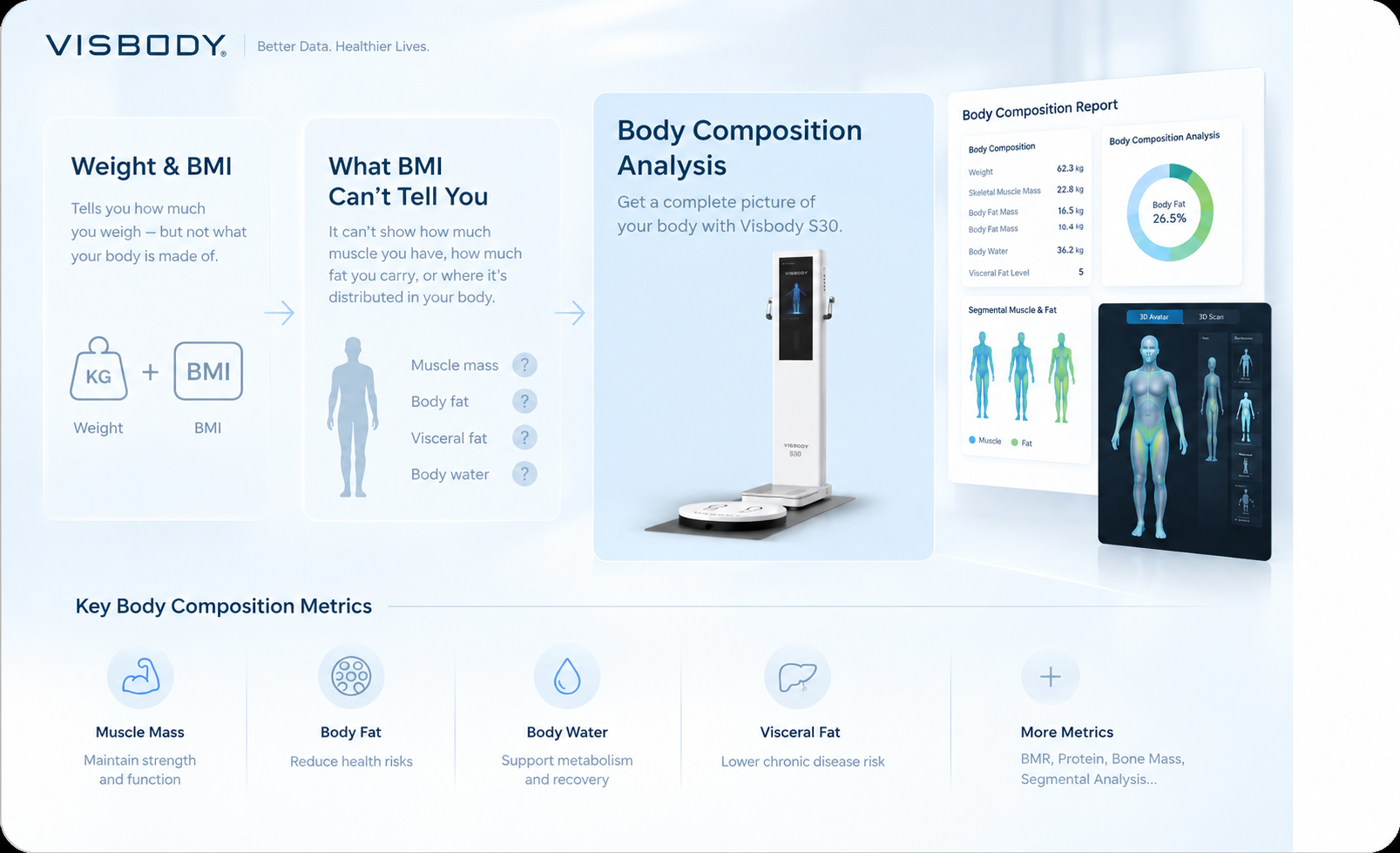
Utmaningen: Två personer kan ha samma vikt men väldigt olika kroppar
För äldre vuxna, Bara BMI kan lämna viktig information utanför bilden.
Två patienter kan ha ett liknande BMI, ändå kan den ena ha relativt välbevarad muskelmassa medan den andra har upplevt betydande muskelförlust tillsammans med en högre nivå av kroppsfett.
På vågen, de kan se likadana ut.
Ur ett kroppssammansättningsperspektiv, dock, de kan representera mycket olika fysiologiska profiler.
Detta är en anledning till att sarkopeni har blivit ett allt viktigare fokus inom åldrande och klinisk forskning.
Snarare än att förlita sig på en enda mätning, studien övervägde flera dimensioner av fysisk status, Inklusive muskelmassa, kroppsfett, muskelstyrka, och fysisk funktion, och använde dessa mått för att klassificera patienter i olika kroppssammansättningsfenotyper.
Bland de 222 deltagare som ingår i analysen:
- 59 hade varken sarkopeni eller fetma
- 62 hade fetma utan sarkopeni
- 74 hade sarkopeni utan fetma
- 27 hade både sarkopeni och fetma
Medianåldern för studiepopulationen var 82.15 år.
I en befolkning så här gamla och kliniskt komplexa, Att veta någons vikt är bara en del av historien.
Den mer meningsfulla frågan är:
Vad är den vikten gjord av - och hur förändras den sammansättningen?
Tillvägagångssättet: Integrera Visbody S30 i multimodal kroppssammansättningsbedömning
Att bygga en mer heltäckande bild av varje patients fysiska status, forskargruppen kombinerade flera bedömningsmetoder.
De Visbody S30 användes till BIA (Bioelektrisk impedansanalys) mätning av kroppssammansättning, med de resulterande data som används för att beräkna det appendikulära skelettmuskelns massindex (ASMI).
På samma gång, forskare använde datortomografi för att bedöma skelettmuskelområdet på kotnivå L3, samtidigt som muskelstyrka och andra kliniska mått ingår i analysen.
Med andra ord, Visbody var inte avsett att ersätta CT eller andra kliniska bedömningar.
Istället, det fungerade som en komponent i ett bredare arbetsflöde för klinisk forskning, tillhandahålla kvantitativa kroppssammansättningsdata som kan övervägas tillsammans med andra etablerade mätningar.
Detta är en viktig distinktion.
Värdet med Visbody är inte att en enhet behöver ersätta varje klinisk bedömning.
Snarare, digital kroppssammansättningsmätning kan bli en praktisk del av ett befintligt forskningsarbetsflöde – vilket hjälper forskare att fånga upp kvantifierbara kroppssammansättningsdata och integrera dem med andra kliniska mätningar.
De Visbody S30 kombinerar 3D-kroppsskanning med BIA-baserad kroppssammansättningsanalys, tillhandahålla mätningar relaterade till muskelmassa, kroppsfett, kroppsvatten, och andra parametrar för kroppssammansättning.
Utforska Visbody S30 3D Body Scanner →
Forskningsresultat: Varför muskelmassa kan betyda mer än kroppsvikten ensam
Fynden illustrerar ytterligare varför kroppssammansättningen förtjänar en närmare titt.
Jämfört med deltagare utan sarkopeni, de med sarkopeni eller sarkopenisk fetma hade lägre greppstyrka, ASMI, och CT-uppmätt L3 skelettmuskelarea, tillsammans med sämre mått på fysisk funktion.
I studiens riskanalys, sarkopeni-relaterade fenotyper var associerade med högre uppskattad 10-årig dödlighetsrisk.
Multivariabel analys visade vidare att både sarkopeni och fetma var oberoende associerade med högre uppskattad dödsrisk, med sarkopeni visar det starkare sambandet.
Dessa fynd väcker en bedrägligt enkel fråga:
Om allt vi vet är någons kroppsvikt, hur mycket vet vi egentligen om deras fysiska status?
För äldre vuxna med CKD, svaret kan vara: inte tillräckligt.
3D kroppsskanning och kroppssammansättningsanalys kan ge ytterligare ett lager av information– inte bara hur mycket en person väger, men hur den vikten är fördelad mellan muskler och fett, och hur dessa komponenter kan förändras över tiden.
Från en enda mätning till longitudinell spårning
Värdet av kroppssammansättningsdata i klinisk forskning går utöver en enda mätning.
Det som spelar roll är hur kroppen förändras över tiden – om muskelmassan minskar, kroppsfett ökar, eller kroppssammansättningen svarar på förändringar i sjukdomen, näring, träning, eller ingripande.
Med standardiserad kroppssammansättningsanalys, forskare och vårdpersonal kan fastställa en baslinje och jämföra resultat över uppföljningsbedömningar:
Baslinje → Intervention → Uppföljning → Jämförelse
Från en enda mätning till en förändringsbana.
Detta är ett viktigt steg i utvecklingen av Kroppssammansättningsanalys mot longitudinell hälsoledning och klinisk forskning.
Takeaway: Gör kroppssammansättningen mätbar
I denna studie av 222 äldre vuxna med CKD, forskare använde Visbody S30 för BIA-baserad kroppssammansättningsmätning, integrera data med CT, muskelstyrka, och andra kliniska åtgärder för att undersöka kroppssammansättningsfenotyper och uppskattade hälsorisker.
Betydelsen av detta fall är inte att Visbody ersätter befintliga kliniska bedömningar. Snarare, det visar hur digital kroppssammansättningsmätning kan integreras i ett befintligt kliniskt forskningsarbetsflöde.
Potentiella applikationer inkluderar:
- Geriatrisk forskning
- CKD-forskning
- Sarkopeni forskning
- Näringshantering
- Rehabiliteringsforskning
- Klinisk bedömning av kroppssammansättning
För sjukhus, forskningsinstitutioner, och vårdpersonal, kroppssammansättning kan bli mer än en engångsmätning – det kan det vara mätt, spåras, jämfört, och övervakas över tid.
Genom att göra kroppssammansättningen mätbar blir långsiktiga förändringar lättare att se.
Ansvarsfriskrivning för vetenskaplig forskning
De Vetenskapliga rapporter studien använde Visbody S30 för BIA-baserad kroppssammansättningsmätning som en del av ett bredare kliniskt forskningsprotokoll.
Studien var inte en oberoende validering av noggrannheten eller diagnostisk prestanda hos Visbody S30, och de rapporterade dödlighets- och funktionsnedsättningsresultaten var uppskattade riskpoäng snarare än observerade händelser under prospektiv uppföljning.
Fynden ska därför tolkas som föreningar, inte bevis på orsakssamband.
Källa
Vetenskapliga rapporter — Sarkopenisk fetma och kroppssammansättningsfenotyper hos äldre vuxna med kronisk njursjukdom: föreningar med beräknad dödsrisk
Serie Studies av ”Iuliu Hatieganu” Universitetet för medicin och farmaci
Studie 1: Visbody S30 stödjer sarkopeni och kroppssammansättningsbedömning hos äldre vuxna
Studie 3: Aktuell artikel