


Compreendendo a composição corporal em idosos com DRC
Para idosos que vivem com doença renal crônica (DRC), o estado de saúde é muito mais complexo do que um número na escala pode nos dizer.
O peso corporal pode permanecer relativamente estável enquanto a massa muscular diminui, gordura corporal aumenta, e alterações na função física.
É por isso que a investigação em geriatria e gestão de doenças crónicas está cada vez mais a olhar para além do peso e do IMC, em direcção a uma compreensão mais completa da análise de composição corporal.
A 2026 estudo realizado por pesquisadores do “Iuliu Hatieganu” Universidade de Medicina e Farmácia e publicado em Relatórios Científicos, parte do portfólio Springer Nature, exploraram esta questão em uma população de idosos com DRC.
O estudo incluiu 222 pacientes com idade 70 e mais velho e utilizou uma avaliação geriátrica abrangente juntamente com uma análise multimodal da composição corporal para examinar a relação entre a sarcopenia, obesidade, obesidade sarcopênica, e riscos estimados de mortalidade e incapacidade.
Como parte do estudo, pesquisadores usaram o Visbody S30 para medição de composição corporal baseada em BIA, juntamente com a avaliação da massa muscular baseada em TC.
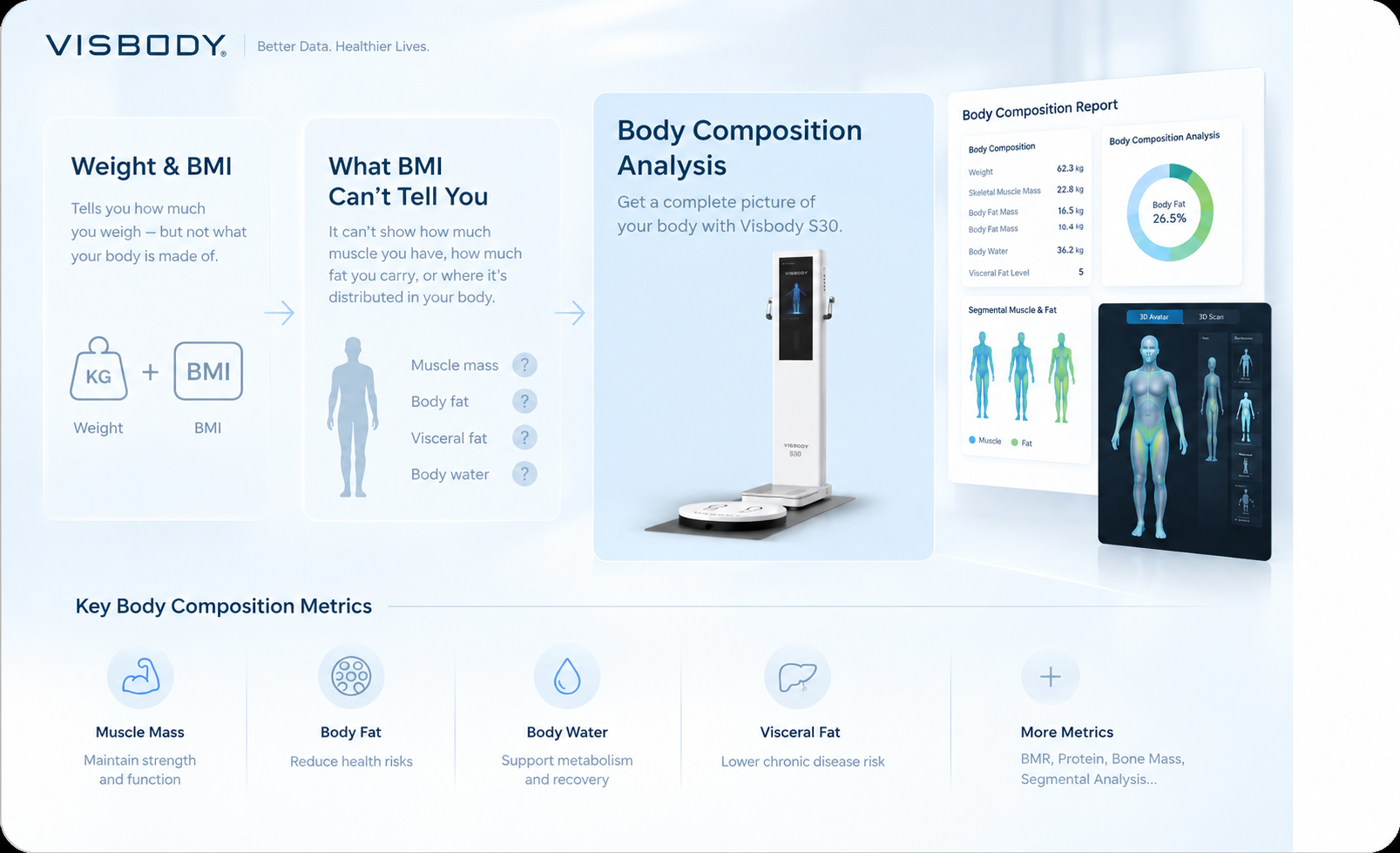
O Desafio: Duas pessoas podem ter o mesmo peso, mas corpos muito diferentes
Para adultos mais velhos, O IMC por si só pode deixar informações importantes fora de cena.
Dois pacientes podem ter IMC semelhante, ainda assim, um pode ter massa muscular relativamente bem preservada, enquanto o outro sofreu perda muscular substancial juntamente com um nível mais elevado de gordura corporal..
Na escala, eles podem parecer semelhantes.
Do ponto de vista da composição corporal, no entanto, eles podem representar perfis fisiológicos muito diferentes.
Esta é uma das razões pelas quais a sarcopenia se tornou um foco cada vez mais importante no envelhecimento e na investigação clínica..
Em vez de confiar em uma única medição, o estudo considerou múltiplas dimensões do estado físico, Incluindo massa muscular, corpo gordo, força muscular, e função física, e usou essas medidas para classificar os pacientes em diferentes fenótipos de composição corporal.
Entre os 222 participantes incluídos na análise:
- 59 não tinha sarcopenia nem obesidade
- 62 tinha obesidade sem sarcopenia
- 74 teve sarcopenia sem obesidade
- 27 tinha sarcopenia e obesidade
A idade mediana da população estudada foi 82.15 anos.
Numa população tão antiga e clinicamente complexa, saber o peso de alguém é apenas parte da história.
A pergunta mais significativa é:
Do que é feito esse peso – e como essa composição está mudando?
A abordagem: Integrando Visbody S30 na avaliação de composição corporal multimodal
Para construir uma imagem mais abrangente do estado físico de cada paciente, a equipe de pesquisa combinou vários métodos de avaliação.
O Visbody S30 foi usado para BIA (Análise de Impedância Bioelétrica) medição de composição corporal, com os dados resultantes usados para calcular o índice de massa muscular esquelética apendicular (ASMI).
Ao mesmo tempo, os pesquisadores usaram imagens de tomografia computadorizada para avaliar a área do músculo esquelético no nível vertebral L3, ao mesmo tempo que incorpora força muscular e outras medidas clínicas na análise.
Em outras palavras, Visbody não se destina a substituir a tomografia computadorizada ou outras avaliações clínicas.
Em vez de, serviu como um componente de um fluxo de trabalho de pesquisa clínica mais amplo, fornecendo dados quantitativos de composição corporal que podem ser considerados juntamente com outras medidas estabelecidas.
Esta é uma distinção importante.
O valor do Visbody não é que um dispositivo precise substituir todas as avaliações clínicas.
Em vez de, a medição digital da composição corporal pode se tornar uma parte prática de um fluxo de trabalho de pesquisa existente, ajudando os pesquisadores a capturar dados quantificáveis de composição corporal e integrá-los a outras medidas clínicas.
O Visbody S30 combina digitalização corporal 3D com análise de composição corporal baseada em BIA, fornecendo medidas relacionadas à massa muscular, corpo gordo, água corporal, e outros parâmetros de composição corporal.
Explorar o Scanner corporal Visbody S30 3D →
Resultados da pesquisa: Por que a massa muscular pode ser mais importante do que apenas o peso corporal
As descobertas ilustram ainda mais por que a composição corporal merece uma análise mais detalhada.
Comparado com participantes sem sarcopenia, aqueles com sarcopenia ou obesidade sarcopênica tiveram menor força de preensão, ASMI, e área do músculo esquelético L3 medida por TC, juntamente com medidas mais pobres de função física.
Na análise de risco do estudo, fenótipos relacionados à sarcopenia foram associados a maior risco estimado de mortalidade em 10 anos.
A análise multivariada indicou ainda que tanto a sarcopenia como a obesidade estavam independentemente associadas a um maior risco estimado de mortalidade, com sarcopenia mostrando a associação mais forte.
Essas descobertas levantam uma questão aparentemente simples:
Se tudo o que sabemos é o peso corporal de alguém, quanto realmente sabemos sobre seu estado físico?
Para idosos com DRC, a resposta pode ser: não é suficiente.
3D a varredura corporal e a análise da composição corporal podem fornecer outra camada de informação-não simplesmente quanto uma pessoa pesa, mas como esse peso é distribuído entre músculo e gordura, e como esses componentes podem mudar ao longo do tempo.
Da medição única ao rastreamento longitudinal
O valor dos dados de composição corporal na pesquisa clínica vai além de uma única medição.
O que importa é como o corpo muda ao longo do tempo – se a massa muscular diminui, gordura corporal aumenta, ou a composição corporal responde a mudanças na doença, nutrição, exercício, ou intervenção.
Com padronizado análise de composição corporal, pesquisadores e profissionais de saúde podem estabelecer uma linha de base e comparar os resultados nas avaliações de acompanhamento:
Linha de base → Intervenção → Acompanhamento → Comparação
De uma única medição a uma trajetória de mudança.
Este é um passo importante na evolução da Análise da Composição Corporal em direção à gestão longitudinal da saúde e à pesquisa clínica.
A conclusão: Tornando a composição corporal mensurável
Neste estudo de 222 idosos com DRC, pesquisadores usaram o Visbody S30 para medição de composição corporal baseada em BIA, integrando os dados com CT, força muscular, e outras medidas clínicas para investigar fenótipos de composição corporal e riscos estimados para a saúde.
A importância deste caso não é que o Visbody substitua as avaliações clínicas existentes. Em vez de, demonstra como a medição digital da composição corporal pode ser integrada a um fluxo de trabalho de pesquisa clínica existente.
As aplicações potenciais incluem:
- Pesquisa geriátrica
- Pesquisa de DRC
- Pesquisa sobre sarcopenia
- Gestão nutricional
- Pesquisa de reabilitação
- Avaliação clínica da composição corporal
Para hospitais, instituições de pesquisa, e profissionais de saúde, a composição corporal pode se tornar mais do que uma medida única – pode ser medido, rastreado, comparado, e monitorado ao longo do tempo.
Tornar a composição corporal mensurável torna as mudanças a longo prazo mais fáceis de ver.
Isenção de responsabilidade de pesquisa científica
O Relatórios Científicos estudo usou o Visbody S30 para medição de composição corporal baseada em BIA como um componente de um protocolo de pesquisa clínica mais amplo.
O estudo foi não é uma validação independente da precisão ou desempenho de diagnóstico do Visbody S30, e os resultados de mortalidade e incapacidade relatados foram escores de risco estimados em vez de eventos observados durante o acompanhamento prospectivo.
As conclusões devem, portanto, ser interpretadas como associações, não é evidência de causalidade.
Fonte
Relatórios Científicos — Obesidade sarcopênica e fenótipos de composição corporal em idosos com doença renal crônica: associações com risco estimado de mortalidade
Série Estudos por “Iuliu Hatieganu” Universidade de Medicina e Farmácia
Estudar 1: Visbody S30 apoia a avaliação da sarcopenia e da composição corporal em adultos mais velhos
Estudar 3: Artigo Atual