


Verständnis der Körperzusammensetzung bei älteren Erwachsenen mit CKD
Für ältere Erwachsene mit chronischer Nierenerkrankung (CKD), Der Gesundheitszustand ist weitaus komplexer als das, was uns eine Zahl auf der Skala sagen kann.
Das Körpergewicht kann relativ stabil bleiben, während die Muskelmasse abnimmt, Körperfett nimmt zu, und körperliche Funktionsänderungen.
Aus diesem Grund konzentriert sich die Forschung in der Geriatrie und im Management chronischer Krankheiten zunehmend auf ein umfassenderes Verständnis über Gewicht und BMI hinaus Analyse der Körperzusammensetzung.
A 2026 Studie durchgeführt von Forschern des “Iuliu Hatieganu” Universität für Medizin und Pharmazie und veröffentlicht in Wissenschaftliche Berichte, Teil des Springer Nature-Portfolios, untersuchten dieses Problem bei einer Population älterer Erwachsener mit CKD.
Die Studie umfasste 222 Patienten im Alter 70 und älter und verwendeten eine umfassende geriatrische Beurteilung zusammen mit einer multimodalen Analyse der Körperzusammensetzung, um den Zusammenhang zwischen Sarkopenie zu untersuchen, Fettleibigkeit, sarkopenische Fettleibigkeit, und geschätzte Sterblichkeits- und Invaliditätsrisiken.
Im Rahmen der Studie, Forscher nutzten die Visbody S30 zur BIA-basierten Messung der Körperzusammensetzung, neben der CT-basierten Beurteilung der Muskelmasse.
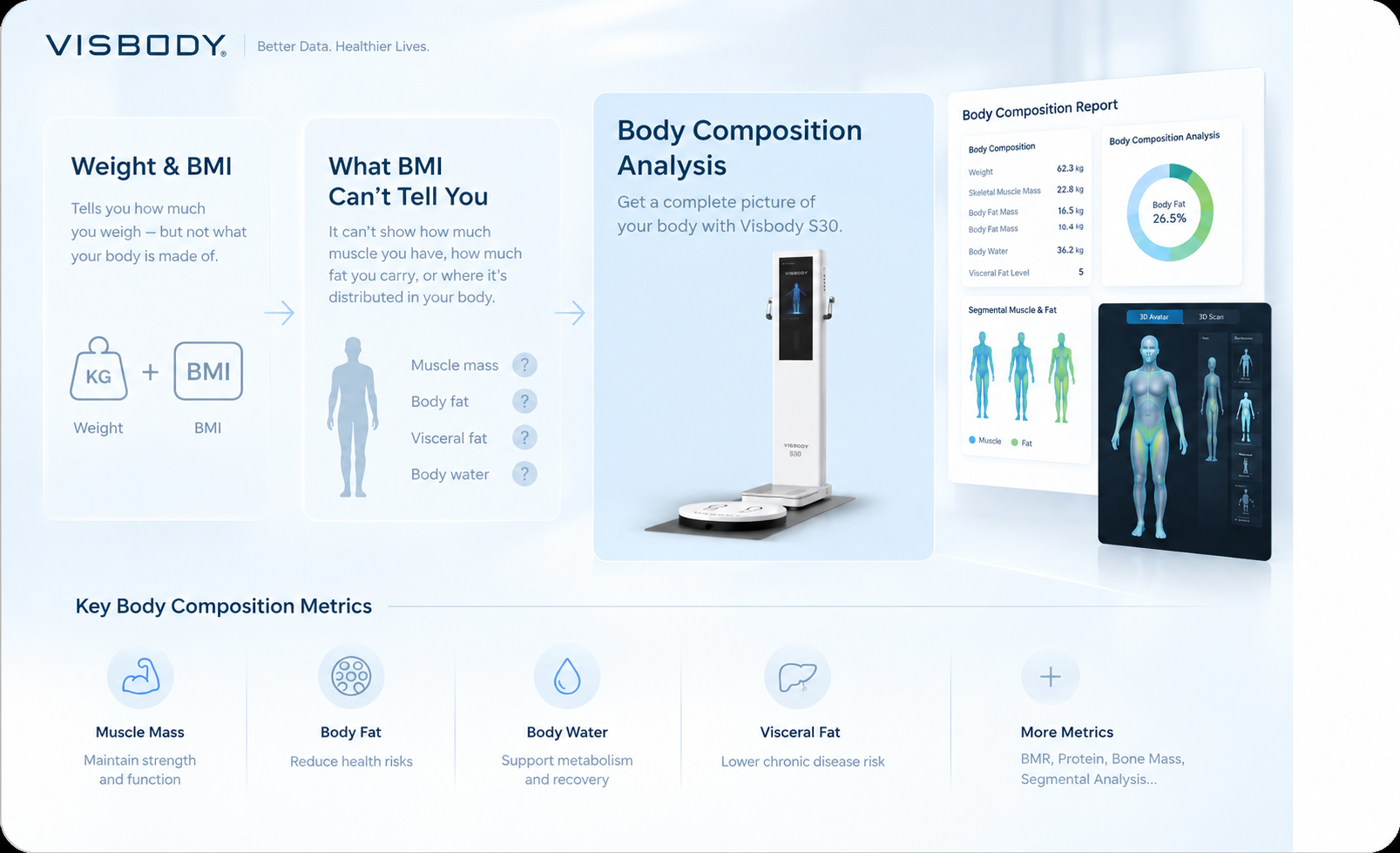
Die Herausforderung: Zwei Menschen können das gleiche Gewicht, aber sehr unterschiedliche Körper haben
Für ältere Erwachsene, Allein der BMI kann wichtige Informationen außer Acht lassen.
Zwei Patienten können einen ähnlichen BMI haben, Dennoch kann es sein, dass der eine über eine relativ gut erhaltene Muskelmasse verfügt, während der andere neben einem höheren Körperfettanteil einen erheblichen Muskelverlust erlitten hat.
Auf der Waage, sie können ähnlich aussehen.
Aus Sicht der Körperzusammensetzung, Jedoch, sie können sehr unterschiedliche physiologische Profile darstellen.
Dies ist einer der Gründe, warum Sarkopenie zu einem immer wichtigeren Schwerpunkt in der Alterungs- und klinischen Forschung geworden ist.
Anstatt sich auf eine einzige Messung zu verlassen, Die Studie berücksichtigte mehrere Dimensionen des körperlichen Zustands, einschließlich Muskelmasse, Körperfett, Muskelkraft, und körperliche Funktion, und nutzten diese Messungen, um Patienten in verschiedene Phänotypen der Körperzusammensetzung zu klassifizieren.
Unter den 222 Teilnehmer, die in die Analyse einbezogen wurden:
- 59 hatte weder Sarkopenie noch Fettleibigkeit
- 62 hatte Fettleibigkeit ohne Sarkopenie
- 74 hatte Sarkopenie ohne Fettleibigkeit
- 27 hatte sowohl Sarkopenie als auch Fettleibigkeit
Das Durchschnittsalter der Studienpopulation betrug 82.15 Jahre.
In einer Bevölkerung, die so alt und klinisch komplex ist, Das Gewicht einer Person zu kennen, ist nur ein Teil der Geschichte.
Die sinnvollere Frage ist:
Woraus besteht dieses Gewicht – und wie verändert sich diese Zusammensetzung??
Der Ansatz: Integration von Visbody S30 in die multimodale Beurteilung der Körperzusammensetzung
Um ein umfassenderes Bild des körperlichen Zustands jedes Patienten zu erhalten, Das Forschungsteam kombinierte mehrere Bewertungsmethoden.
Der Visbody S30 wurde verwendet für BIA (Bioelektrische Impedanzanalyse) Messung der Körperzusammensetzung, Die resultierenden Daten werden zur Berechnung des appendikulären Skelettmuskelmassenindex verwendet (ASMI).
Gleichzeitig, Die Forscher nutzten die CT-Bildgebung, um den Bereich der Skelettmuskulatur auf der Ebene des L3-Wirbels zu beurteilen, Dabei werden auch Muskelkraft und andere klinische Maßnahmen in die Analyse einbezogen.
Mit anderen Worten, Visbody war nicht als Ersatz für CT oder andere klinische Untersuchungen gedacht.
Stattdessen, Es diente als eine Komponente eines umfassenderen Arbeitsablaufs für die klinische Forschung, Bereitstellung quantitativer Daten zur Körperzusammensetzung, die neben anderen etablierten Messungen berücksichtigt werden könnten.
Dies ist eine wichtige Unterscheidung.
Der Wert von Visbody besteht nicht darin, dass ein Gerät jede klinische Beurteilung ersetzen muss.
Eher, Die digitale Messung der Körperzusammensetzung kann ein praktischer Bestandteil eines bestehenden Forschungsworkflows werden und Forschern dabei helfen, quantifizierbare Daten zur Körperzusammensetzung zu erfassen und diese mit anderen klinischen Messungen zu integrieren.
Der Visbody S30 kombiniert 3D-Körperscanning mit BIA-basierter Analyse der Körperzusammensetzung, Bereitstellung von Messungen zur Muskelmasse, Körperfett, Körperwasser, und andere Parameter der Körperzusammensetzung.
Entdecken Sie die Visbody S30 3D-Körperscanner →
Forschungsergebnisse: Warum Muskelmasse wichtiger sein kann als das Körpergewicht allein
Die Ergebnisse veranschaulichen weiter, warum die Körperzusammensetzung eine genauere Betrachtung verdient.
Im Vergleich zu Teilnehmern ohne Sarkopenie, diejenigen mit Sarkopenie oder sarkopenischer Adipositas hatten niedrigere Werte Griffstärke, ASMI, und CT-gemessener L3-Skelettmuskelbereich, zusammen mit schlechteren Messungen der körperlichen Funktion.
In der Risikoanalyse der Studie, Sarkopenie-bedingte Phänotypen waren mit einem höheren geschätzten 10-Jahres-Mortalitätsrisiko verbunden.
Die multivariate Analyse zeigte außerdem, dass sowohl Sarkopenie als auch Fettleibigkeit unabhängig voneinander mit einem höheren geschätzten Mortalitätsrisiko verbunden waren, mit Sarkopenie zeigt den stärkeren Zusammenhang.
Diese Erkenntnisse werfen eine täuschend einfache Frage auf:
Wenn wir nur das Körpergewicht einer Person wissen, Wie viel wissen wir wirklich über ihren körperlichen Zustand??
Für ältere Erwachsene mit CKD, Die Antwort könnte sein: nicht genug.
3D-Körperscans und Körperzusammensetzungsanalysen können eine weitere Informationsebene liefern– nicht nur, wie viel eine Person wiegt, sondern wie dieses Gewicht verteilt ist Muskeln und Fett, und wie sich diese Komponenten im Laufe der Zeit verändern können.
Von der Einzelmessung zur Längsverfolgung
Der Wert von Daten zur Körperzusammensetzung in der klinischen Forschung geht über eine einzelne Messung hinaus.
Entscheidend ist, wie sich der Körper im Laufe der Zeit verändert – ob die Muskelmasse abnimmt, Körperfett nimmt zu, oder die Körperzusammensetzung reagiert auf Veränderungen im Krankheitsverlauf, Ernährung, Übung, oder Intervention.
Mit standardisierter Analyse der Körperzusammensetzung, Forscher und Gesundheitsexperten können eine Basislinie erstellen und die Ergebnisse von Folgeuntersuchungen vergleichen:
Baseline → Intervention → Follow-up → Vergleich
Von einer einzelnen Messung zu einem Verlauf der Veränderung.
Dies ist ein wichtiger Schritt in der Entwicklung von Analyse der Körperzusammensetzung hin zu Längsschnitt-Gesundheitsmanagement und klinischer Forschung.
Der Imbiss: Körperzusammensetzung messbar machen
In dieser Studie von 222 ältere Erwachsene mit CKD, Forscher nutzten die Visbody S30 zur BIA-basierten Messung der Körperzusammensetzung, Integration der Daten mit CT, Muskelkraft, und andere klinische Maßnahmen zur Untersuchung der Phänotypen der Körperzusammensetzung und der geschätzten Gesundheitsrisiken.
Die Bedeutung dieses Falles besteht nicht darin, dass Visbody bestehende klinische Bewertungen ersetzt. Eher, es zeigt wie Die digitale Messung der Körperzusammensetzung kann in einen bestehenden klinischen Forschungsworkflow integriert werden.
Mögliche Anwendungen umfassen:
- Geriatrische Forschung
- CKD-Forschung
- Sarkopenieforschung
- Ernährungsmanagement
- Rehabilitationsforschung
- Klinische Beurteilung der Körperzusammensetzung
Für Krankenhäuser, Forschungseinrichtungen, und Gesundheitsfachkräfte, Die Körperzusammensetzung kann mehr als eine einmalige Messung sein – sie kann es sein gemessen, verfolgt, verglichen, und im Laufe der Zeit überwacht.
Durch die Messbarkeit der Körperzusammensetzung lassen sich langfristige Veränderungen besser erkennen.
Haftungsausschluss für wissenschaftliche Forschung
Der Wissenschaftliche Berichte Studie verwendet die Visbody S30 zur BIA-basierten Messung der Körperzusammensetzung als eine Komponente eines umfassenderen klinischen Forschungsprotokolls.
Die Studie war keine unabhängige Validierung der Genauigkeit oder Diagnoseleistung des Visbody S30, und die gemeldeten Mortalitäts- und Invaliditätsergebnisse waren geschätzte Risikowerte und nicht beobachtete Ereignisse während der prospektiven Nachuntersuchung.
Die Ergebnisse sollten daher als interpretiert werden Verbände, kein Beweis für eine Kausalität.
Quelle
Wissenschaftliche Berichte — Sarkopenische Fettleibigkeit und Phänotypen der Körperzusammensetzung bei älteren Erwachsenen mit chronischer Nierenerkrankung: Assoziationen mit dem geschätzten Mortalitätsrisiko
Reihe Studien von “Iuliu Hatieganu” Universität für Medizin und Pharmazie
Studie 3: Aktueller Artikel